UI / UX Design
NPOWER
IA Redesign: Making opportunity easier to access.
Role:
Lead UX Designer
Industry:
Workforce Development
Team:
Product, Engineering, Program Operations
Project Duration:
3-week contract

Overview:
NPower provides tuition-free tech education to underserved communities, and their application process is the gateway to that access. As the organization grew, the experience failed to evolve alongside it — what began as a collection of forms had become a fragmented, difficult-to-navigate system that served neither applicants nor the internal reviewers responsible for evaluating them.
I led UX design on a 3-week sprint to revamp the application as a cohesive end-to-end experience. The new design incorporated IF/THEN logic so the application adapted in real time to each applicant's answers. The result was clearer for applicants, more consistent for reviewers, and scalable enough to support NPower's expanding program offerings.

The Problem:
The application had grown organically — questions added over time, nothing removed, no consistent structure. Applicants had no sense of how far they were, what remained, or whether their submission had been received correctly. When the team mapped the existing flow end-to-end, internal stakeholders were genuinely surprised that applicants were completing the process at all.
But the applicant experience was only half the problem. Reviewers were piecing together information across disconnected views, slowing decisions during time-sensitive admissions cycles. The two problems were connected — and fixing one without the other would only move the friction, not eliminate it.

Process:
Research ran on both tracks simultaneously, because the design challenge wasn't "simplify the form" — it was "build one system that serves two completely different definitions of success."
On the applicant side, interviews with alumni, current applicants, and people who had abandoned the process revealed consistent themes: the application felt long and intimidating, progress was invisible, and submission offered no confirmation that anything had been received or reviewed. On the reviewer side, a multi-part design studio with six internal stakeholder groups — Recruitment & Admissions, Program Operations, Advanced Training, Social Support, Marketing, and Data & Systems — revealed that different teams evaluated applications through different lenses, and all of them needed consistent, structured data to make fair decisions at scale. The design couldn't just reduce applicant friction without considering what the restructuring would do to the reviewer's workflow.
Four research themes shaped everything that followed: clear navigation and expectations reduce abandonment, eligibility criteria need to surface early so applicants aren't wasted deep in a process they don't qualify for, progress visibility builds trust, and silence after submission is worse than any outcome — applicants need confirmation in either direction.

Design:
Before any wireframes, the team needed agreement on what information actually mattered. A closed card sort had stakeholders independently rank every existing application question by necessity, clarity, and decision value. The exercise exposed significant redundancy and surfaced questions that added friction without meaningfully supporting admissions decisions — several were removed entirely, including two of the most time-consuming items.
An open card sort then mapped how stakeholders naturally grouped the remaining content. Rather than imposing predefined categories, the recurring patterns in how people mentally organized the information became the structural foundation for the redesigned application. A collaborative sequencing exercise with the full stakeholder group validated the end-to-end flow and identified moments where applicants were likely to hesitate or lose confidence in the middle of the process.
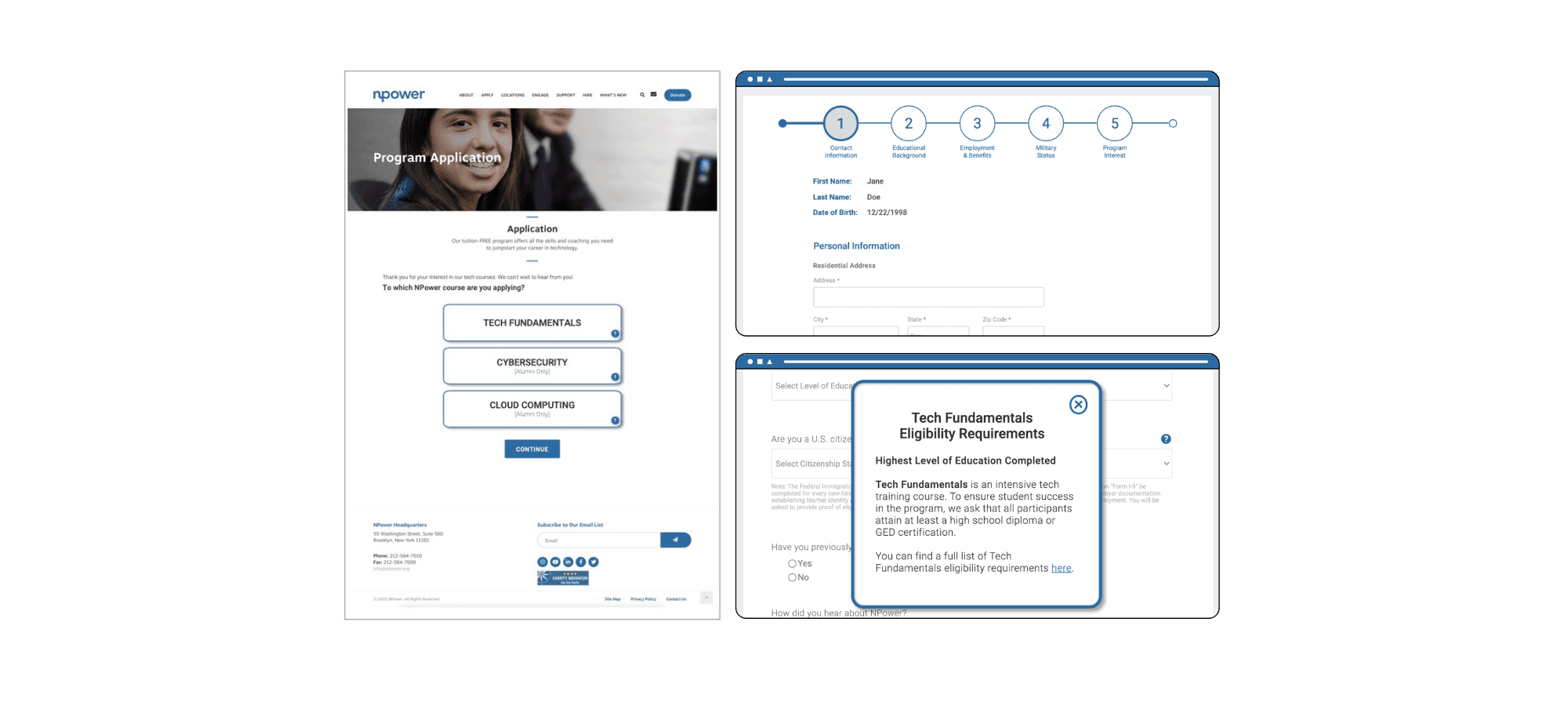
Wireframes followed with a tight focus on three questions every applicant needed answered at every step: where am I, why is this being asked, and what comes next. Conditional logic eliminated irrelevant questions rather than just hiding them. Eligibility criteria surfaced in the first section so applicants who didn't qualify weren't wasted deep in a process they couldn't complete. Sensitive questions — including SSN and military status — included inline explanations of why the information was needed and how it would be used.

The Solution:
A program-specific step indicator sets expectations from the first page — applicants see exactly how many sections exist and where they are throughout. Sections align with how applicants naturally think about their own background (contact, education, employment, military status, program interest), broken into focused steps rather than presented as one continuous form.
Behind the scenes, the information architecture was designed around reviewer needs — ensuring applicants' responses arrived as consistent, structured, decision-ready data regardless of which program or cohort they applied to. Reviewers got what they needed without new tools or additional workflows. The two experiences were designed as a system, not separately.
Impact & Reflection
The engagement concluded before full implementation, with production-ready design elements, a functional prototype, and written recommendations handed off to support continued iteration. Katharine Riggle, NPower's Director of Marketing Operations: "Thank you for all of this great work and your time, patience, and sharp insights throughout the entire project. We are thrilled with the outcome."
What this project clarified: the most important research finding often isn't what users say — it's figuring out whose problem you're actually solving. The answer here wasn't "make the form shorter." It was recognizing that applicants and reviewers were locked in opposing needs, and that a real solution had to serve both without sacrificing either. The card sort methodology gave us a way to surface that alignment before a single wireframe existed — and made the eventual design decisions much easier to defend.
More Projects


UI / UX Design
NPOWER
IA Redesign: Making opportunity easier to access.
Role:
Lead UX Designer
Industry:
Workforce Development
Team:
Product, Engineering, Program Operations
Project Duration:
3-week contract
Overview:
NPower provides tuition-free tech education to underserved communities, and their application process is the gateway to that access. As the organization grew, the experience failed to evolve alongside it — what began as a collection of forms had become a fragmented, difficult-to-navigate system that served neither applicants nor the internal reviewers responsible for evaluating them.
I led UX design on a 3-week sprint to revamp the application as a cohesive end-to-end experience. The new design incorporated IF/THEN logic so the application adapted in real time to each applicant's answers. The result was clearer for applicants, more consistent for reviewers, and scalable enough to support NPower's expanding program offerings.
The Problem:
The application had grown organically — questions added over time, nothing removed, no consistent structure. Applicants had no sense of how far they were, what remained, or whether their submission had been received correctly. When the team mapped the existing flow end-to-end, internal stakeholders were genuinely surprised that applicants were completing the process at all.
But the applicant experience was only half the problem. Reviewers were piecing together information across disconnected views, slowing decisions during time-sensitive admissions cycles. The two problems were connected — and fixing one without the other would only move the friction, not eliminate it.
Process:
Research ran on both tracks simultaneously, because the design challenge wasn't "simplify the form" — it was "build one system that serves two completely different definitions of success."
On the applicant side, interviews with alumni, current applicants, and people who had abandoned the process revealed consistent themes: the application felt long and intimidating, progress was invisible, and submission offered no confirmation that anything had been received or reviewed. On the reviewer side, a multi-part design studio with six internal stakeholder groups — Recruitment & Admissions, Program Operations, Advanced Training, Social Support, Marketing, and Data & Systems — revealed that different teams evaluated applications through different lenses, and all of them needed consistent, structured data to make fair decisions at scale. The design couldn't just reduce applicant friction without considering what the restructuring would do to the reviewer's workflow.
Four research themes shaped everything that followed: clear navigation and expectations reduce abandonment, eligibility criteria need to surface early so applicants aren't wasted deep in a process they don't qualify for, progress visibility builds trust, and silence after submission is worse than any outcome — applicants need confirmation in either direction.
Design:
Before any wireframes, the team needed agreement on what information actually mattered. A closed card sort had stakeholders independently rank every existing application question by necessity, clarity, and decision value. The exercise exposed significant redundancy and surfaced questions that added friction without meaningfully supporting admissions decisions — several were removed entirely, including two of the most time-consuming items.
An open card sort then mapped how stakeholders naturally grouped the remaining content. Rather than imposing predefined categories, the recurring patterns in how people mentally organized the information became the structural foundation for the redesigned application. A collaborative sequencing exercise with the full stakeholder group validated the end-to-end flow and identified moments where applicants were likely to hesitate or lose confidence in the middle of the process.
Wireframes followed with a tight focus on three questions every applicant needed answered at every step: where am I, why is this being asked, and what comes next. Conditional logic eliminated irrelevant questions rather than just hiding them. Eligibility criteria surfaced in the first section so applicants who didn't qualify weren't wasted deep in a process they couldn't complete. Sensitive questions — including SSN and military status — included inline explanations of why the information was needed and how it would be used.
The Solution:
A program-specific step indicator sets expectations from the first page — applicants see exactly how many sections exist and where they are throughout. Sections align with how applicants naturally think about their own background (contact, education, employment, military status, program interest), broken into focused steps rather than presented as one continuous form.
Behind the scenes, the information architecture was designed around reviewer needs — ensuring applicants' responses arrived as consistent, structured, decision-ready data regardless of which program or cohort they applied to. Reviewers got what they needed without new tools or additional workflows. The two experiences were designed as a system, not separately.
Impact & Reflection
The engagement concluded before full implementation, with production-ready design elements, a functional prototype, and written recommendations handed off to support continued iteration. Katharine Riggle, NPower's Director of Marketing Operations: "Thank you for all of this great work and your time, patience, and sharp insights throughout the entire project. We are thrilled with the outcome."
What this project clarified: the most important research finding often isn't what users say — it's figuring out whose problem you're actually solving. The answer here wasn't "make the form shorter." It was recognizing that applicants and reviewers were locked in opposing needs, and that a real solution had to serve both without sacrificing either. The card sort methodology gave us a way to surface that alignment before a single wireframe existed — and made the eventual design decisions much easier to defend.
More Projects
UI / UX Design
NPOWER
IA Redesign: Making opportunity easier to access.
Role:
Lead UX Designer
Industry:
Workforce Development
Team:
Product, Engineering, Program Operations
Project Duration:
3-week contract
Overview:
NPower provides tuition-free tech education to underserved communities, and their application process is the gateway to that access. As the organization grew, the experience failed to evolve alongside it — what began as a collection of forms had become a fragmented, difficult-to-navigate system that served neither applicants nor the internal reviewers responsible for evaluating them.
I led UX design on a 3-week sprint to revamp the application as a cohesive end-to-end experience. The new design incorporated IF/THEN logic so the application adapted in real time to each applicant's answers. The result was clearer for applicants, more consistent for reviewers, and scalable enough to support NPower's expanding program offerings.
The Problem:
The application had grown organically — questions added over time, nothing removed, no consistent structure. Applicants had no sense of how far they were, what remained, or whether their submission had been received correctly. When the team mapped the existing flow end-to-end, internal stakeholders were genuinely surprised that applicants were completing the process at all.
But the applicant experience was only half the problem. Reviewers were piecing together information across disconnected views, slowing decisions during time-sensitive admissions cycles. The two problems were connected — and fixing one without the other would only move the friction, not eliminate it.
Process:
Research ran on both tracks simultaneously, because the design challenge wasn't "simplify the form" — it was "build one system that serves two completely different definitions of success."
On the applicant side, interviews with alumni, current applicants, and people who had abandoned the process revealed consistent themes: the application felt long and intimidating, progress was invisible, and submission offered no confirmation that anything had been received or reviewed. On the reviewer side, a multi-part design studio with six internal stakeholder groups — Recruitment & Admissions, Program Operations, Advanced Training, Social Support, Marketing, and Data & Systems — revealed that different teams evaluated applications through different lenses, and all of them needed consistent, structured data to make fair decisions at scale. The design couldn't just reduce applicant friction without considering what the restructuring would do to the reviewer's workflow.
Four research themes shaped everything that followed: clear navigation and expectations reduce abandonment, eligibility criteria need to surface early so applicants aren't wasted deep in a process they don't qualify for, progress visibility builds trust, and silence after submission is worse than any outcome — applicants need confirmation in either direction.
Design:
Before any wireframes, the team needed agreement on what information actually mattered. A closed card sort had stakeholders independently rank every existing application question by necessity, clarity, and decision value. The exercise exposed significant redundancy and surfaced questions that added friction without meaningfully supporting admissions decisions — several were removed entirely, including two of the most time-consuming items.
An open card sort then mapped how stakeholders naturally grouped the remaining content. Rather than imposing predefined categories, the recurring patterns in how people mentally organized the information became the structural foundation for the redesigned application. A collaborative sequencing exercise with the full stakeholder group validated the end-to-end flow and identified moments where applicants were likely to hesitate or lose confidence in the middle of the process.
Wireframes followed with a tight focus on three questions every applicant needed answered at every step: where am I, why is this being asked, and what comes next. Conditional logic eliminated irrelevant questions rather than just hiding them. Eligibility criteria surfaced in the first section so applicants who didn't qualify weren't wasted deep in a process they couldn't complete. Sensitive questions — including SSN and military status — included inline explanations of why the information was needed and how it would be used.
The Solution:
A program-specific step indicator sets expectations from the first page — applicants see exactly how many sections exist and where they are throughout. Sections align with how applicants naturally think about their own background (contact, education, employment, military status, program interest), broken into focused steps rather than presented as one continuous form.
Behind the scenes, the information architecture was designed around reviewer needs — ensuring applicants' responses arrived as consistent, structured, decision-ready data regardless of which program or cohort they applied to. Reviewers got what they needed without new tools or additional workflows. The two experiences were designed as a system, not separately.
Impact & Reflection
The engagement concluded before full implementation, with production-ready design elements, a functional prototype, and written recommendations handed off to support continued iteration. Katharine Riggle, NPower's Director of Marketing Operations: "Thank you for all of this great work and your time, patience, and sharp insights throughout the entire project. We are thrilled with the outcome."
What this project clarified: the most important research finding often isn't what users say — it's figuring out whose problem you're actually solving. The answer here wasn't "make the form shorter." It was recognizing that applicants and reviewers were locked in opposing needs, and that a real solution had to serve both without sacrificing either. The card sort methodology gave us a way to surface that alignment before a single wireframe existed — and made the eventual design decisions much easier to defend.